Overview
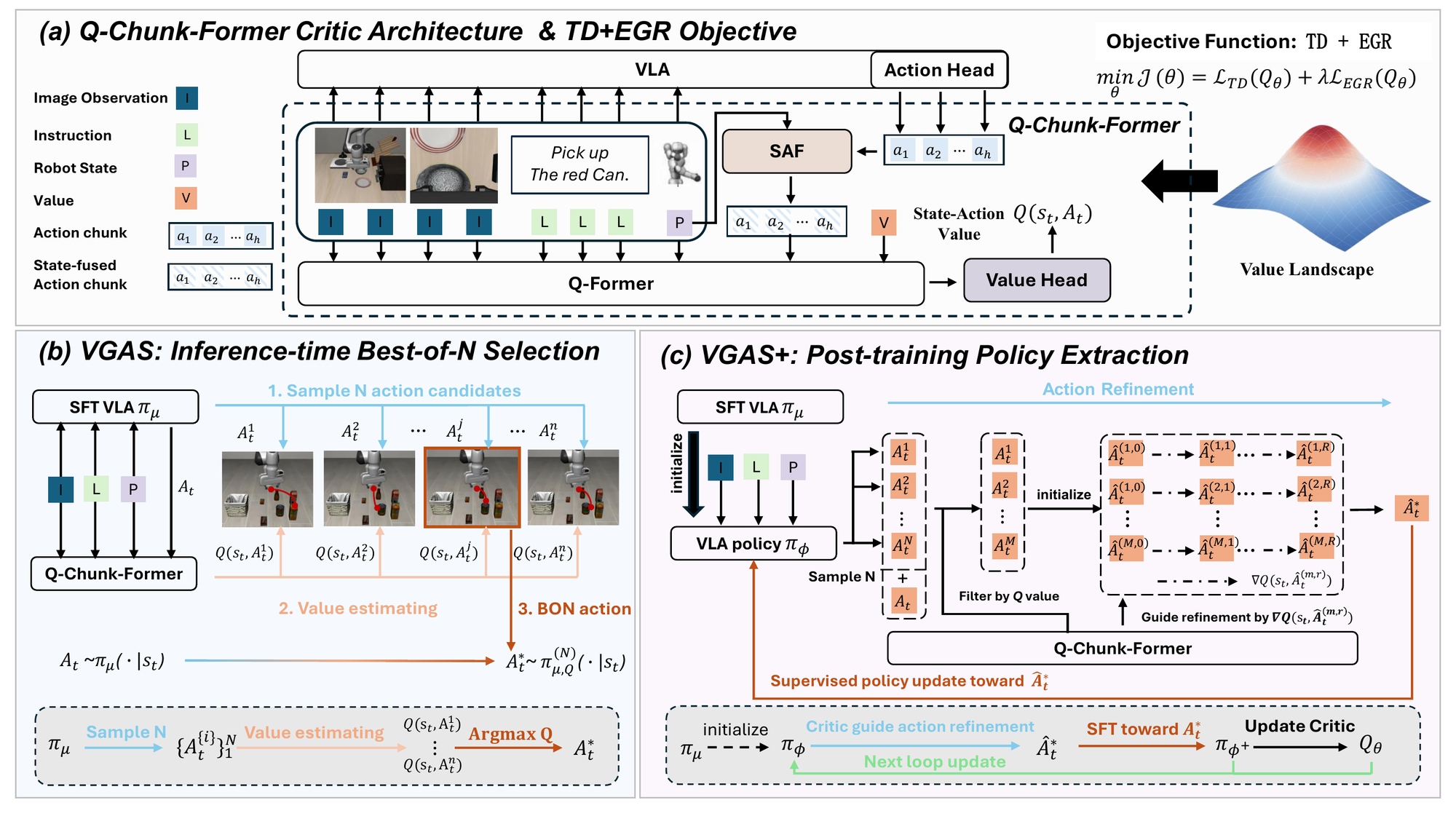
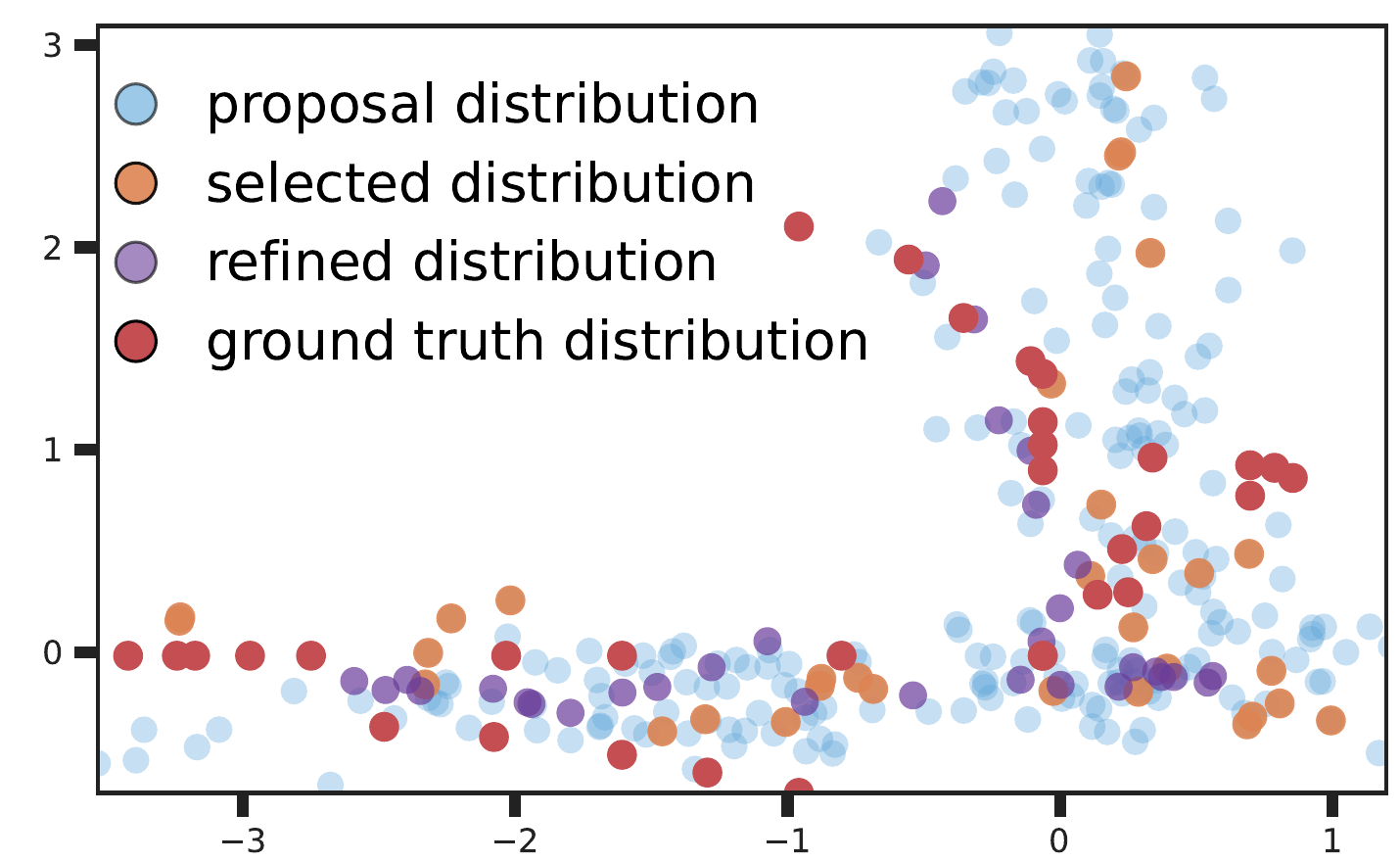
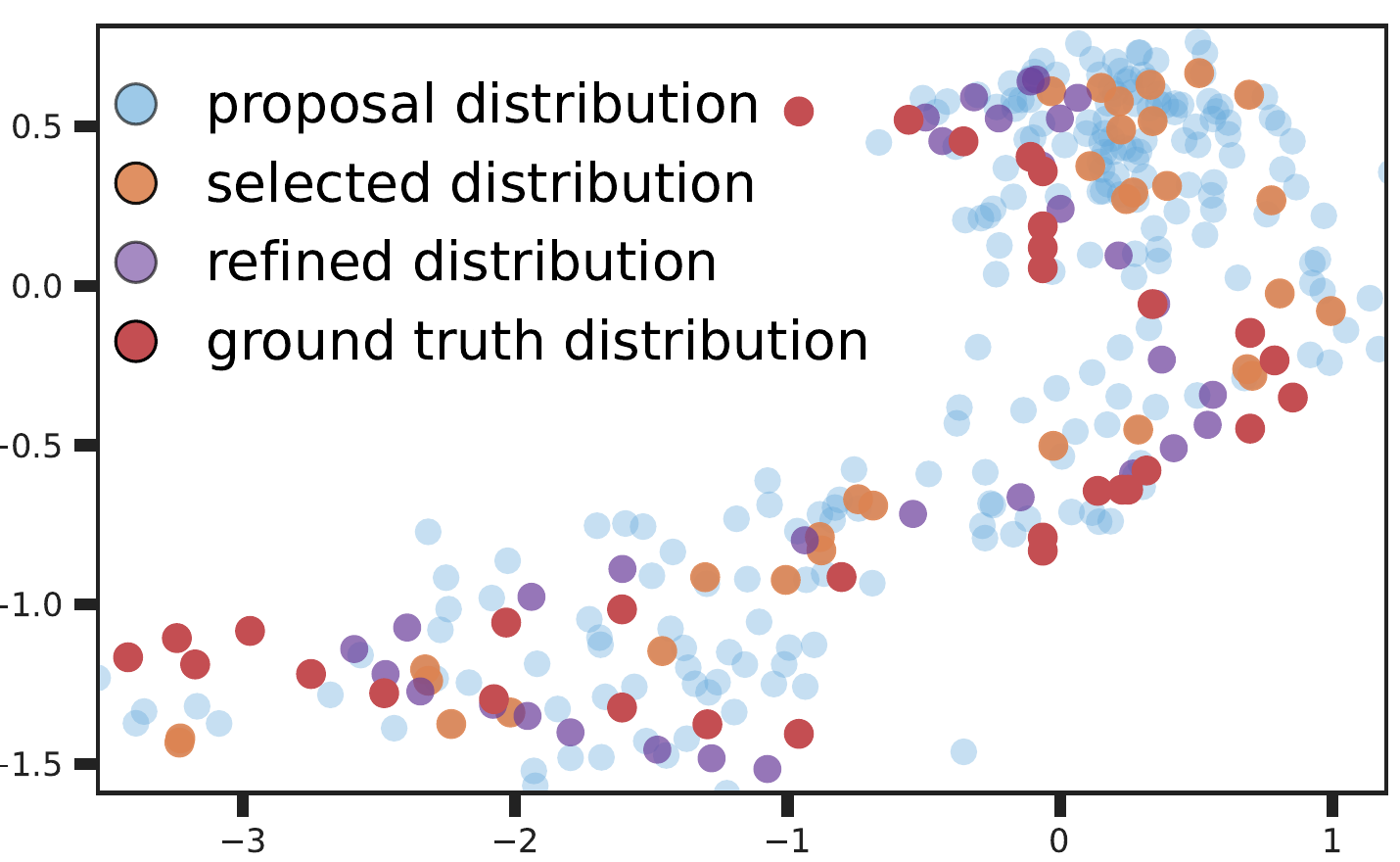
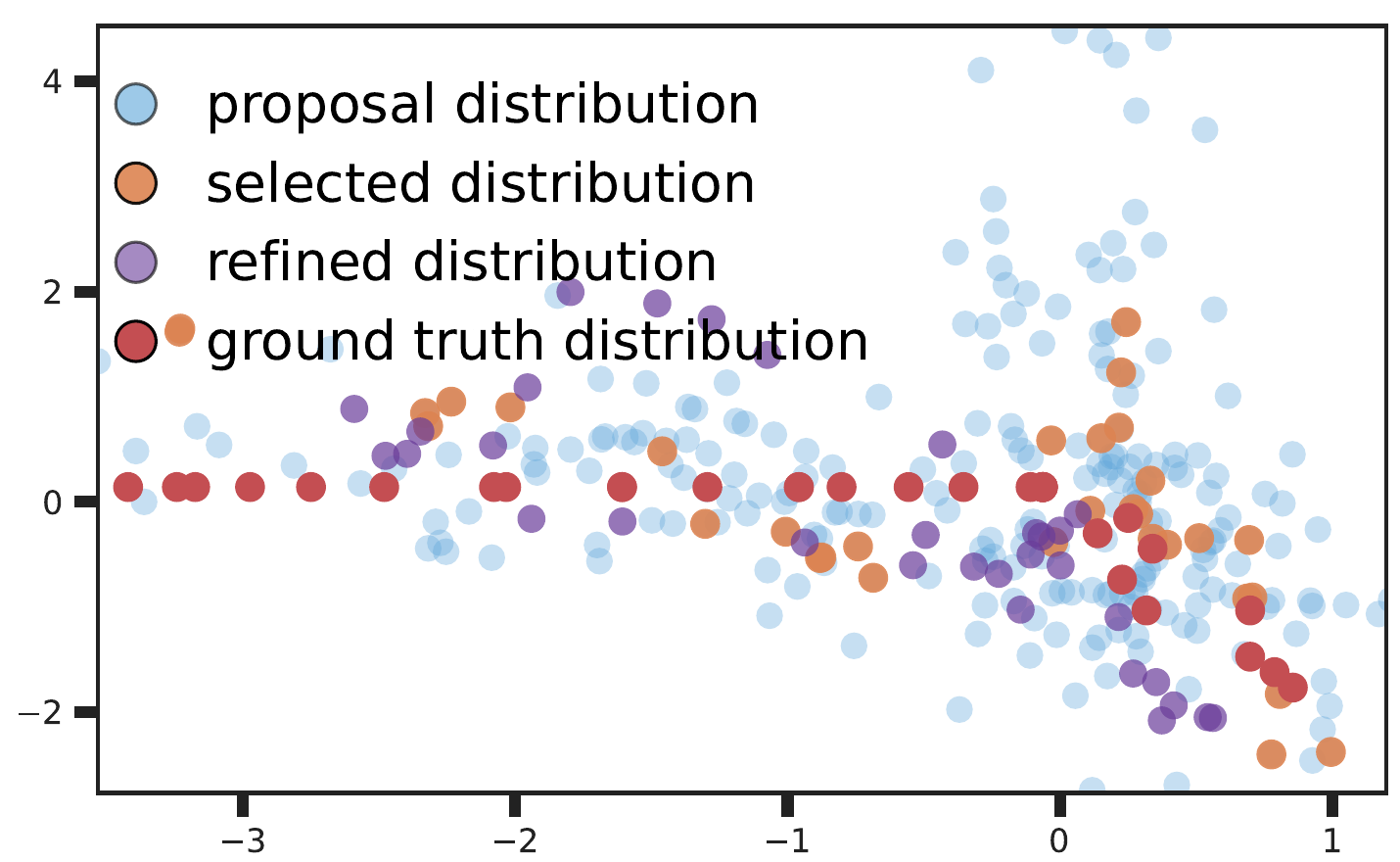
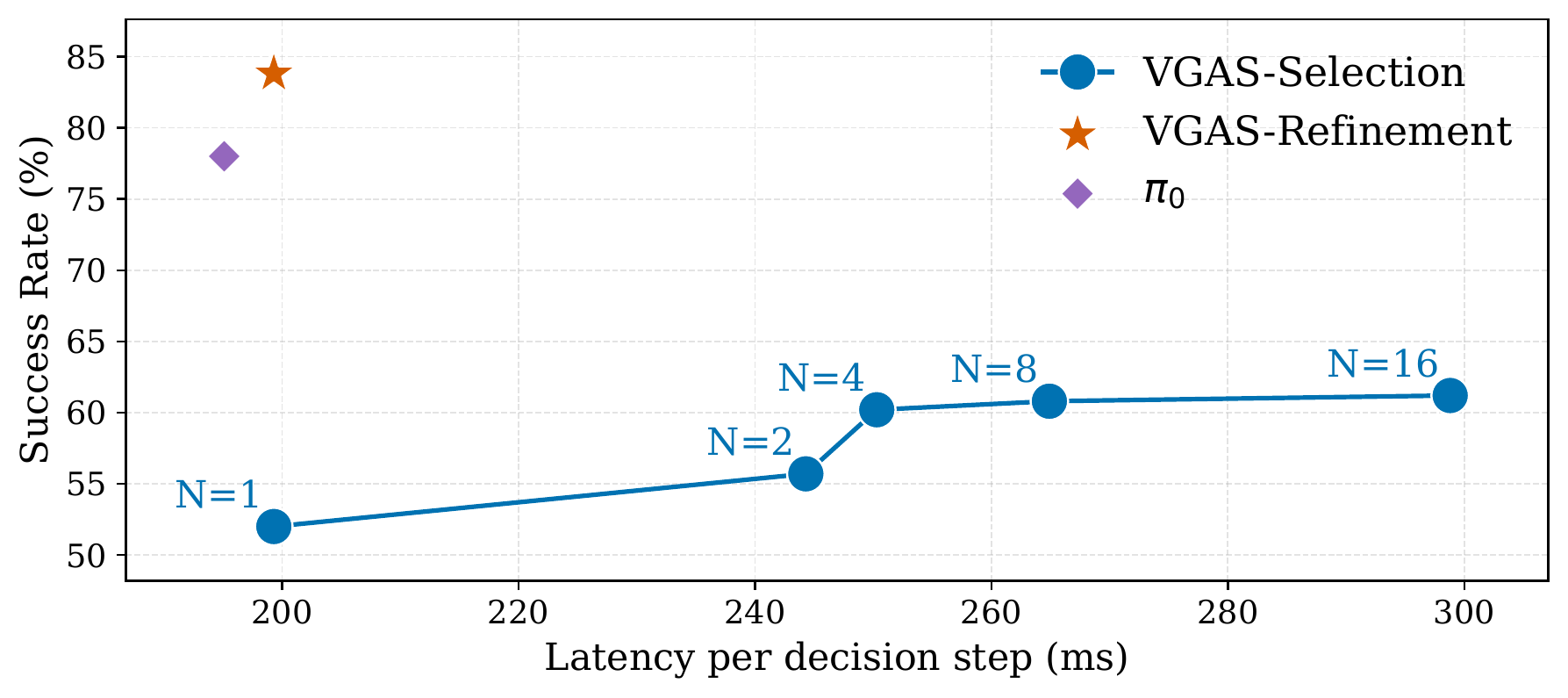
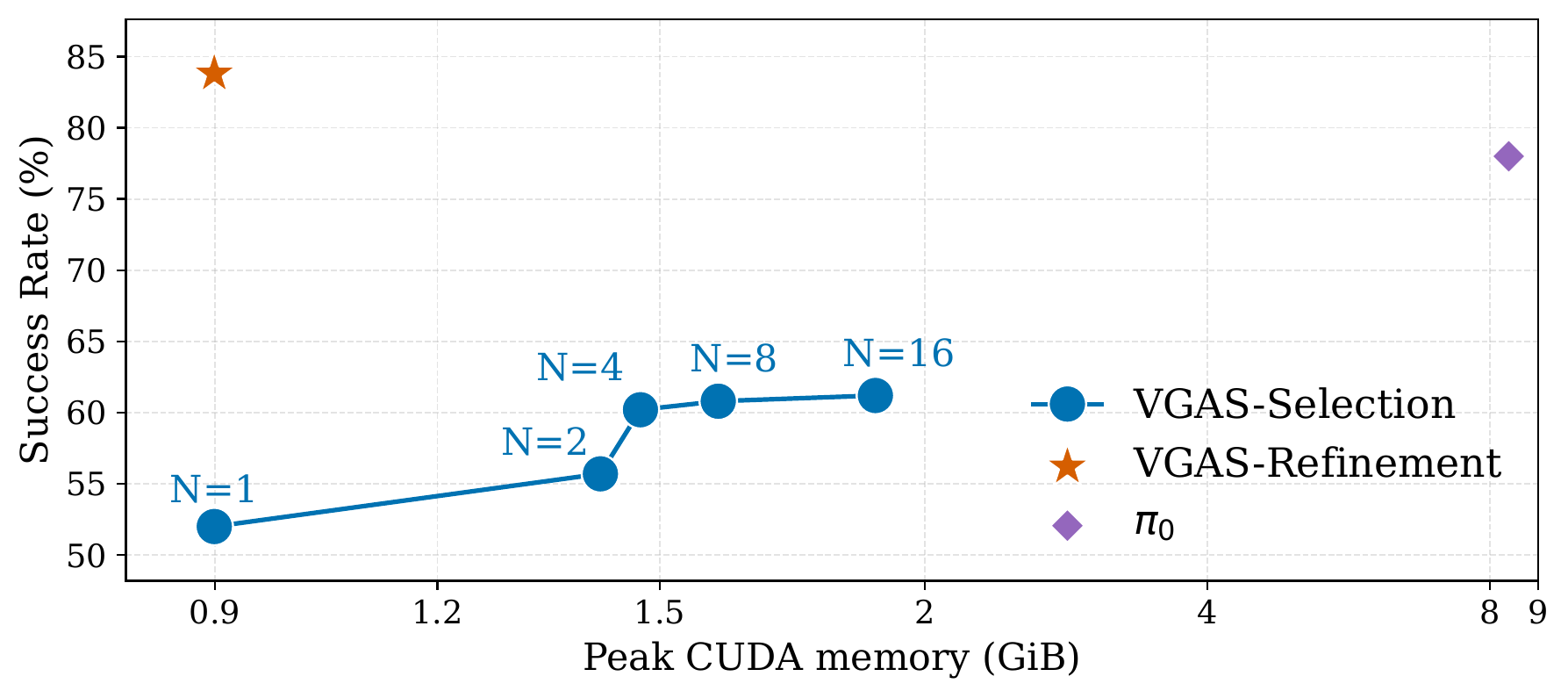
Vision–Language–Action (VLA) models bridge multimodal reasoning with physical control, but adapting them to new tasks with scarce demonstrations remains unreliable. While few-shot SFT policies often produce semantically plausible action chunks, small geometric errors can lead to divergent execution outcomes. We study few-shot VLA adaptation from a value-guided policy improvement perspective, learning a long-horizon critic over temporally extended action chunks. At the core of our approach is the Q-Chunk-Former, a geometrically grounded Transformer critic that maps vision–language observations and proprioceptive states to chunk-level values. To train this critic under scarce demonstrations, we introduce Explicit Geometric Regularization (EGR), which shapes a discriminative value landscape and preserves ranking resolution among near-miss action candidates. Building on this critic, VGAS performs inference-time Best-of-N selection by keeping the SFT policy fixed and executing the candidate chunk with the highest predicted return. We then introduce VGAS+, which extends VGAS with post-training policy extraction: it optimizes candidate chunks in action space and distills the critic-refined targets into the VLA through its native supervised generative objective, avoiding direct critic backpropagation through the flow-matching-based action head. Experiments on LIBERO and MetaWorld, together with theoretical analysis, show that VGAS improves fixed-policy execution, while VGAS+ further outperforms evaluated SFT and offline RL baselines under limited demonstrations.
| Method | Spatial | Object | Goal | Long | Avg. | ΔAvg. |
|---|---|---|---|---|---|---|
| SmolVLA (SFT) | 46.0 | 45.8 | 52.0 | 15.5 | 39.8 | — |
| π0 (SFT, 3.5B) | 66.0 | 71.1 | 78.0 | 43.8 | 64.7 | — |
| QC-M+CQL (Best-of-N) | 47.8 | 50.3 | 54.2 | 16.5 | 42.2 | +2.4 |
| VGAS (ours, Best-of-N) | 56.2 | 59.0 | 60.8 | 20.0 | 49.0 | +9.2 |
| QC-FQL-T (extraction) | 61.7 | 53.9 | 60.1 | 18.1 | 48.4 | +8.6 |
| VGAS+ (ours, extraction) | 77.7 | 77.8 | 83.8 | 41.8 | 70.3 | +30.5 |
| Method | Easy | Medium | Hard | Very-Hard | Avg. |
|---|---|---|---|---|---|
| SmolVLA (SFT) | 56.1 | 17.3 | 7.8 | 19.0 | 25.0 |
| π0 (SFT, 3.5B) | 66.3 | 29.8 | 29.6 | 40.0 | 41.4 |
| QC-FQL-T (extraction) | 56.5 | 19.4 | 30.0 | 38.5 | 36.1 |
| VGAS (ours, Best-of-N) | 56.5 | 19.7 | 9.7 | 20.7 | 26.6 |
| VGAS+ (ours, extraction) | 71.5 | 30.9 | 36.1 | 38.3 | 44.2 |
All values from the paper (mean over 6 evaluation seeds, 50 episodes per task per seed). With a 0.45B SmolVLA base, VGAS+ surpasses the 3.5B π0 on average on both benchmarks. Full comparisons and ablations in the paper.
Each row is one initial state played by all three methods at the same playback speed, so the pace you see is real. Successful runs hold on their final frame.
@article{xu2026vgas,
  title   = {VGAS: Value-Guided Action-Chunk Selection for Few-Shot
             Vision-Language-Action Adaptation},
  author  = {Xu, Changhua and Yu, En and Xuan, Junyu and Lu, Jie},
  journal = {arXiv preprint arXiv:2602.07399},
  year    = {2026}
}

% VGAS+ — preprint coming soon.
% The citation entry will be added here once it is online.